


HPGR has become widely used for material size reduction in the mining industry over the past 30 years. In 1980, Professor Klaus Schönert, through his studies on the physics of material breakage, concluded that the most efficient and effective method of comminution was to subject materials to pressure within a particle bed. Schönert’s research subsequently led to the invention of the HPGR.
In an HPGR, two rolls are positioned parallel to each other with an adjustable gap between them, and the feed material is introduced into the gap between the rolls. As the rolls rotate in opposite directions, the material is gradually drawn into the gap and crushed under the pressure exerted by the two rolls.
Since comminution in an HPGR is achieved through the force applied behind the movable roll, the formation of a material bed above the HPGR rolls is essential for producing the product cake. Furthermore, the longer the material remains between the two rolls, the greater the extent of comminution.
Microscopic images and petrographic investigations conducted on particles discharged from HPGRs have indicated that the use of HPGR for comminution offers the following potential benefits:
The microcracks generated in HPGR products are expected to reduce energy consumption and decrease the consumption of grinding media in downstream ball mills compared with conventional comminution of crushed ores or ores processed using primary Semi-Autogenous Grinding (SAG) mills.
The microfractures generated in HPGR product particles can potentially improve extraction recovery from heap-leaching operations. In addition, column leaching tests have demonstrated that, in many cases, both the leaching rate and the dissolution kinetics of the particles can be improved.
The results of investigations conducted by Baum in 1997 showed that improved mineral liberation achieved through HPGR comminution can increase flotation recovery by approximately 2.5–15% and improve gravity-separation recovery by approximately 2.5-9%.
Effect of HPGR Application on the Processing of Gold-Bearing Ores
The figure below, presented by Baum in 1997, compares the comminution characteristics and cracks generated within a particle after processing by a conventional crushing circuit and an HPGR.
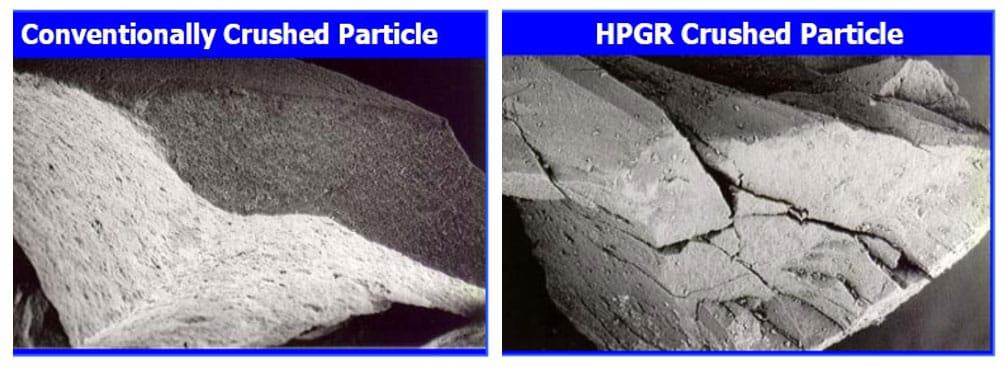
Figure 2 – Liberation of sulfide particles from the sample via fractures induced by HPGR milling.
In addition, the following figure, presented by Baum in 1997, illustrates the excellent liberation of fine sulfide grains within an ore particle following comminution using an HPGR.
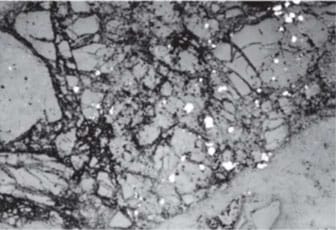
Figure 2 – Liberation of sulfide particles from the sample via fractures induced by HPGR milling.
The following figure compares the results of column leaching tests performed on a Nevada gold ore sample with a high silica content, as well as agitated (rolling-bottle) leaching tests conducted on a semi-refractory Nevada gold ore sample by Patzelt et al. in 1995. The samples were comminuted using conventional crushing processes and HPGR, and the resulting leaching performances were compared.

Dunne et al. (1996) investigated the results of cyanide leaching tests on HPGR-crushed samples using the rolling-bottle technique and compared them with plant operating conditions. The gold extraction results obtained from all leaching tests are summarized in the table below. The test results demonstrated that the use of HPGR not only reduced the amount of residual undissolved gold and significantly improved leaching recovery, but also enhanced the kinetics of the leaching reaction.
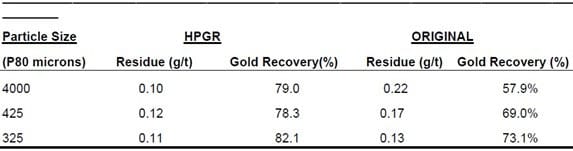
Table 1 – Advantages of HPGR in gold ore cyanide leaching and comparison with plant production results
The results of leaching tests conducted on Witwatersrand gold ore in Australia, as reported by Esna-Ashari & Kellerwessel in 1988, are presented in the table below. In these tests, the HPGR product was screened to a particle size of less than 1 mm and produced at a capacity of 5.0 tonnes per hour with an energy consumption of 4.3 kWh/t. The resulting material was subjected to leaching, achieving a gold recovery of more than 94.7%.
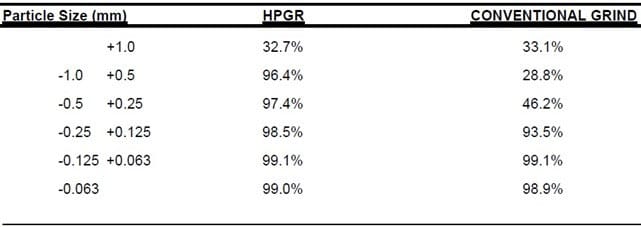
Table 2 – Benefits of using an HPGR mill in the cyanide leaching process for Witwatersrand gold ore (Australia)