Fluorite Flotation
1- Introduction
Fluorite, with the chemical formula CaF₂, is widely used as an important source of fluorine in many industries. Different grades of fluorite are used in the production of cement, glass, ceramics, metallurgy, refrigeration, pharmaceutical, and chemical industries. With increasing industrial development in various regions, many countries have recognized fluorite as a strategic resource.
Currently, flotation is the primary method for the beneficiation of fluorite. In mineral deposits, fluorite is often associated with gangue minerals such as calcite and quartz, which have similar surface properties to fluorite and therefore pose significant challenges to effective separation. Fluorite flotation generally requires a complex process consisting of multiple rougher and cleaner stages to produce a high-grade fluorite concentrate.
2- Heavy-Media Separation
Prior to flotation and the production of a high-grade final product, a preliminary beneficiation and concentration stage based on gravity separation methods can be employed. Due to the specific gravity of fluorite (approximately 3.0-3.3 g/cm³) and the associated gangue minerals (generally less than 2.8 g/cm³), heavy-media separation can be used for preliminary beneficiation.
Because the specific gravities of fluorite and its associated gangue minerals are relatively close, gravity separation alone cannot be used for the complete beneficiation and concentration of fluorite ore. In this method, the specific gravity of the heavy medium is adjusted to approximately 2.8. As a result, gangue minerals, including carbonate and silicate minerals, float, while fluorite, as the valuable product, sinks. The fluorite product is then washed and transferred to flotation cells for further beneficiation. The fluorite concentrate obtained from heavy-media separation typically has a grade of 20–35%.
3- Fluorite Flotation
Fluorite may exhibit hydrophilic or, under certain conditions, hydrophobic behavior. Studies have shown that fluorite possesses slight natural hydrophobicity and can, under certain conditions, be floated in conventional flotation cells without the use of chemicals or surface-active reagents. However, the flotation behavior of fluorite is strongly dependent on pulp pH.
Based on previous studies, the optimum pH for fluorite flotation in pure water or in the presence of chemical reagents is generally within the range of 7–11. Some studies have reported pH 9 as the optimum condition for fluorite flotation.
4- Reagents Used in Fluorite Flotation
4-1- Collectors
In general, collectors used in fluorite flotation can be classified into four groups: anionic, cationic, amphoteric, and microbial collectors. Among these, fatty acids, despite their relatively low solubility in water at low concentrations, are the most commonly used collectors in fluorite flotation.
The use of cationic and amphoteric collectors may introduce several challenges, including increased operating costs and greater process flowsheet complexity. Sodium oleate is one of the most widely used fatty-acid collectors and is employed in fluorite flotation to separate fluorite from quartz and calcite.
Hydroxamic acid is another collector used in fluorite flotation. It can float fluorite under alkaline conditions but is generally weaker than sodium oleate. However, hydroxamic acid provides higher selectivity compared with sodium oleate. Phosphoric acid is another collector that can be used for the separation of fluorite from calcite.
4-2- Depressants
Depressants used in fluorite flotation are generally classified into three groups: organic, inorganic, and combined depressants.
Sodium silicate (water glass) is the most widely used inorganic depressant in fluorite flotation and can effectively depress calcite and silicate gangue minerals. It can also act as a dispersant for fine particles.
After acidification, acidified sodium silicate exhibits greater selectivity in depressing gangue minerals such as calcite and quartz. Sodium hexametaphosphate, sodium pyrophosphate, trisodium phosphate, and sodium tripolyphosphate can also act as depressants for calcite and barite.
Despite their good performance, inorganic depressants may have adverse environmental impacts and can impose additional costs during tailings handling. In contrast, organic depressants have attracted increasing attention due to advantages such as abundant sources, biodegradability, and relatively low cost.
Common organic depressants include starch, dextrin, sodium carboxymethyl cellulose (CMC), sodium lignosulfonate, and tannins.
4-3- pH Regulators
Various reagents are used to adjust the pH of the flotation environment toward alkaline conditions, including sodium hydroxide (NaOH) and sodium carbonate (Na₂CO₃). Research results indicate that sodium carbonate generally performs better than sodium hydroxide. Its addition to the flotation system increases the concentration of CO₃²⁻ ions, which limits the presence of Ca²⁺ and Mg²⁺ ions that are undesirable for fluorite flotation.
Hydrochloric acid (HCl), due to its volatility, and nitric acid (HNO₃), due to its oxidizing properties, are generally not used as pH regulators in this process. Sulfuric acid (H₂SO₄) is widely used in cleaner flotation stages to establish an acidic environment. Studies have shown that the addition of sulfuric acid can reduce calcite recovery.
4-4- Frothers
In fluorite flotation, the froth phase is one of the most important components of the process because it strongly influences both the quality and grade of the final product as well as the overall recovery.
Among the frothers used in fluorite flotation, methyl isobutyl carbinol (MIBC) and terpineol are among the most commonly used. The presence of relatively large amounts of long-chain fatty alcohols in terpineol can promote its attachment to gangue mineral surfaces and consequently affect concentrate grade and recovery.
Compared with terpineol, MIBC can more effectively reduce the entrainment and concentration of unwanted gangue minerals while improving fluorite recovery.
5- Effect of Temperature on Fluorite Flotation
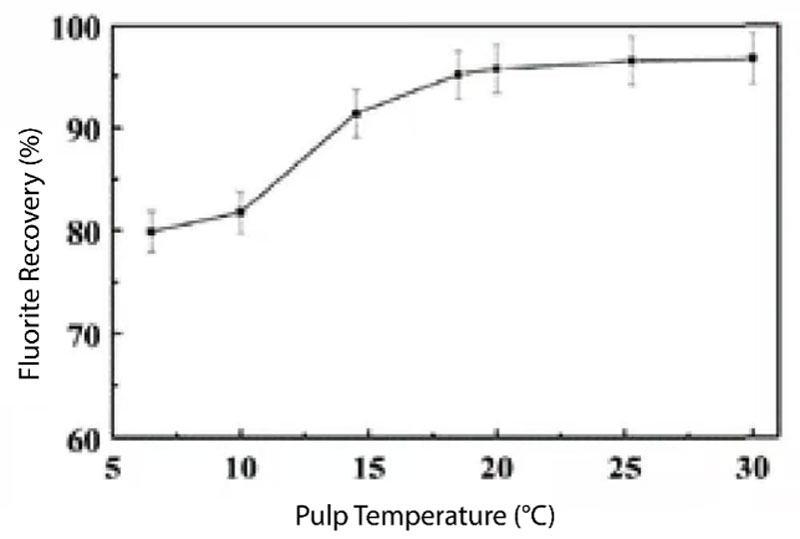
As mentioned above, fatty acids are the most widely used collectors in fluorite flotation. The flotation performance of these collectors is strongly dependent on pulp temperature.
To improve the performance of fluorite flotation, the pulp temperature can be controlled within the range of 35–85 °C through heating. Research has shown that increasing the pulp temperature can improve fluorite flotation recovery.