


A Review of Stirred Mills in the Mineral Processing Industry
1- Introduction
The growing demand for fine and ultrafine grinding in mineral processing has introduced new challenges to the industry, particularly in grinding operations. At the same time, energy efficiency has become a key consideration in the design and optimization of comminution and grinding circuits. The efficiency of stirred mills has been demonstrated across a wide range of industries. This technology provides a modern, sophisticated, flexible, and energy-efficient solution for fine and ultrafine grinding in mineral processing. Fine grinding technology is particularly applied to the regrinding of concentrates to achieve further liberation of valuable minerals following the initial concentration stage. Maintaining an appropriate particle size distribution and target product size is critical to the performance of downstream processes. Stirred mills enable improved control and online optimization of the particle size distribution of the ground product.
The introduction of stirred mill technology has significantly enhanced the ability to achieve finer degrees of liberation and improve the recovery of valuable minerals. Major applications of these mills in the mining industry include the liberation of finely disseminated gold, magnetite, copper-lead-zinc, and platinum minerals, where the required liberation size is typically 15 μm or finer.
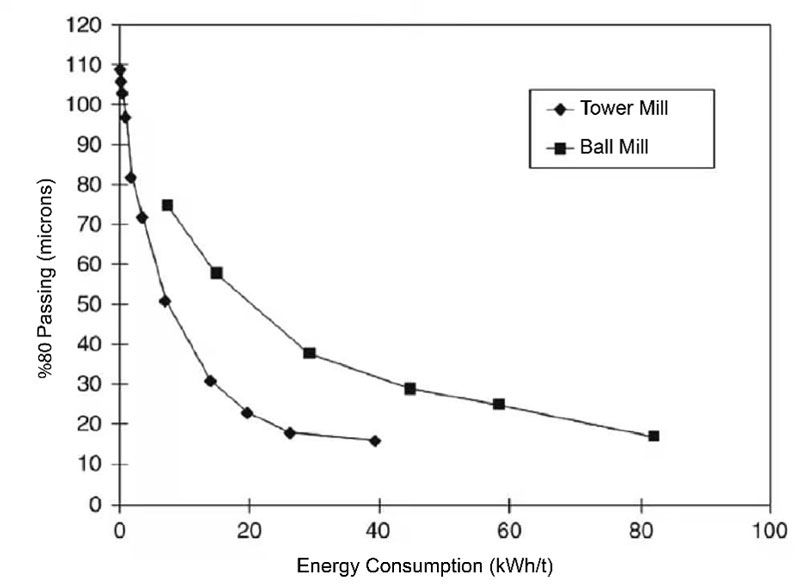
Stirred mills can consume approximately 30–40% less energy than conventional ball mills, while also offering lower capital costs in many applications.
2- Types of Stirred Mills
Based on their operating mechanism, stirred mills can generally be classified into two categories: gravity-induced and fluidized-bed. In gravity-induced mills, the agitator screw rotates slowly, allowing the grinding media and pulp to settle under gravity. In contrast, fluidized-bed mills use high-speed rotating discs or impellers to suspend and thoroughly mix the grinding media and particles within the pulp. As a result of fluidization, the mineral particles and grinding media remain in continuous contact, and their relative movement reduces particle size primarily through an attrition mechanism.
1-2- Gravity-Induced Stirred Mills
1-1-2- Vertimill
Unlike conventional ball mills, in which the mill shell rotates, the Vertimill has a stationary shell with a rotating screw agitator. Due to the significant amount of heat generated during operation, the mill shell can be cooled using water. The grinding mechanism is associated with the rotation and centrifugal effects generated by the screw, discs, or pins, which create high shear stresses within the pulp between the grinding media and mineral particles. These high shear stresses generate an attrition effect, resulting in particle size reduction.
Vertimills use the rotational movement of the screw to generate the grinding forces required for the process. The rotational speed is relatively low, with the agitator operating at a maximum peripheral speed of approximately 3 m/s. The product size can reach P80 values below 15 μm, while grinding media size typically ranges from 5 to 38 mm, depending on the mineral being processed.
2-1-2- Tower Mill
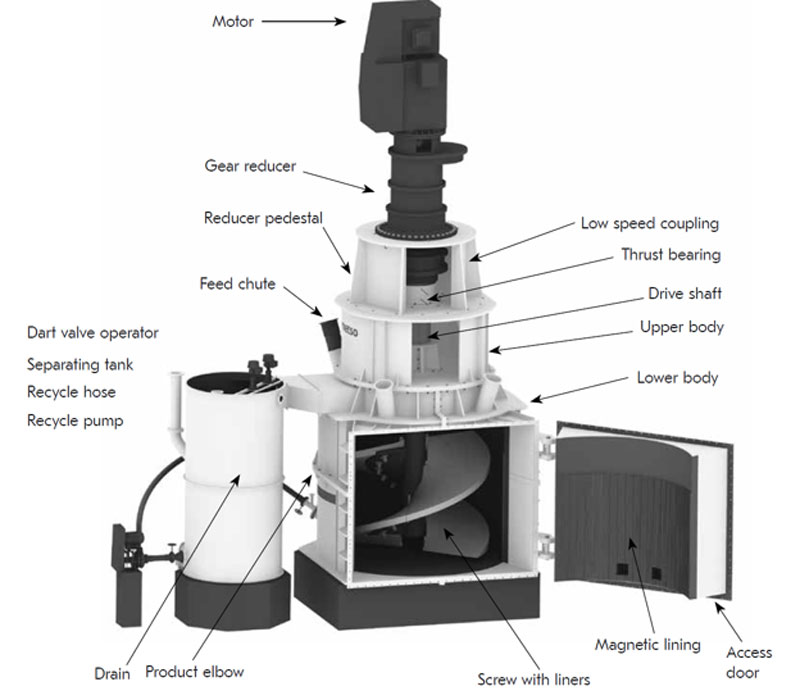
The Tower Mill was the first gravity-induced stirred mill and was developed by Japanese Tower Mill in 1980. Its main design feature is a centrally located screw-shaped agitator. The agitator is the only moving component of the mill and operates in direct contact with the pulp and steel grinding media, providing particle size reduction through attrition.
This design can reduce energy consumption by up to 50% compared with conventional horizontal ball mills for equivalent feed and product sizes.
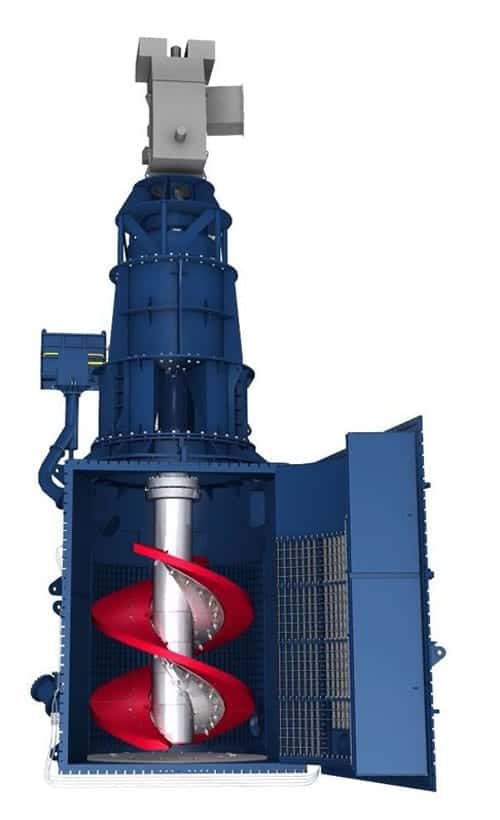
Figure 3- Tower Mill
2-2- Fluidized-Bed Stirred Mills
1-2-2- Stirred Media Detritor (SMD)
The Stirred Media Detritor (SMD) is a fluidized-bed stirred mill. Rotational energy generated by the impeller arms is used to provide energy and mix the grinding media and pulp. This produces particle-to-particle shear and compressive forces, creating the grinding mechanism required for fine particle size reduction.
Typical SMD operating parameters include a feed particle size of approximately 60–115 μm (maximum 250 μm), a product size of 10–30 μm (minimum 5 μm), grinding media size of 2–6 mm, depending on the application, and specific energy consumption in the range of approximately 5–100 kWh/t.
2-2-2- Isa Mill
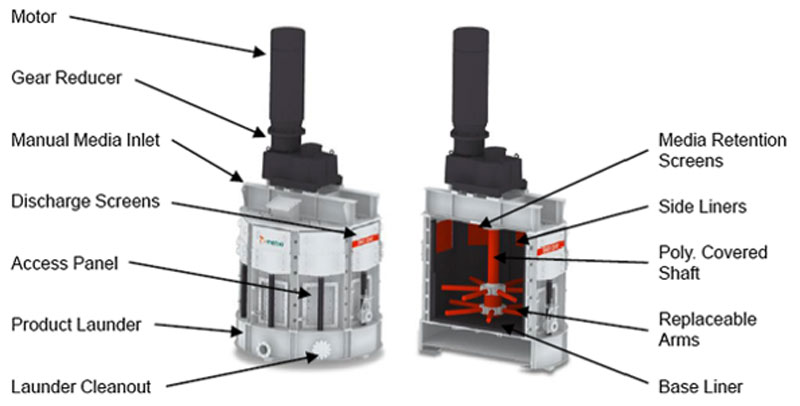
The IsaMill was developed in Australia by Mount Isa Mines Limited in collaboration with Nietzsche Feinmahltechnik, Germany, initially for fine grinding of lead-zinc concentrates at the Mount Isa operation.
Today, IsaMills are used in mineral processing applications for the liberation of finely disseminated minerals including gold, platinum, copper, zinc, nickel and molybdenum. Their high energy efficiency, short residence time, and relatively low capital and operating costs have enabled them to increasingly replace conventional grinding technologies in ultrafine grinding applications.
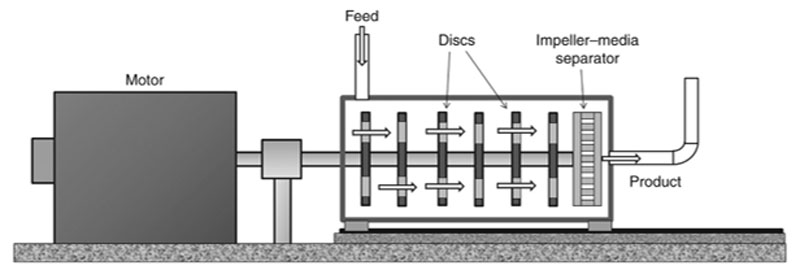
Similar to vertical stirred mills, the IsaMill has a stationary shell. Grinding energy is generated by a centrally located high-speed rotating spindle equipped with perforated discs. The openings in the discs are designed to promote pulp movement toward the discharge end. The spacing between the discs is generally uniform, except for the final disc.
The final disc is designed to act as a centrifugal separator, separating the grinding media from the ground product. Larger particles separated and collected by the centrifugal action can be returned to the mill for further grinding.
Smaller IsaMills typically have capacities of approximately 10–30 t/h, while larger units can achieve capacities of around 125 t/h, producing particles in the approximate size range of 45–170 μm, depending on the application. Typical residence time is between 0.5 and 1 minute, while motor power can reach or exceed 3,000 kW for high-speed disc rotation.
3-2-2- VXP Mill
VXP mills operate at higher power intensities than conventional low-speed stirred mills, with peripheral speeds of approximately 10–12 m/s, overlapping with the operating range of high-speed stirred mills. This enables the VXP mill to be applied across a broad range of grinding applications.
The VXP mill is a vertical stirred mill equipped with a modular impeller incorporating removable discs and spacers. Pulp enters through the bottom of the mill and moves upward through the grinding chamber before overflowing through the grinding media retaining screen at the top.
Rotating polyurethane discs activate the inert ceramic grinding media within the grinding chamber. This activation fluidizes the grinding media bed and promotes particle size reduction through attrition. The system is designed so that changing the number and spacing of the impeller discs can modify the distribution of grinding media and energy within the mill.

Figure 6 – VXP mill
4-2-2- HIG Mill
The HIG mill (High-Intensity Grinding Mill) consists of a grinding chamber, a shaft equipped with grinding discs, counter-rings mounted on the mill body, a gearbox, and a drive system. The grinding chamber can be filled with grinding media to approximately 70% of its volume.
The rotating discs agitate the grinding media, and grinding takes place through attrition between the grinding media and mineral particles. Feed pulp is pumped into the mill through the bottom connection. As the pulp moves upward, it passes sequentially through the individual grinding stages. The final product is discharged from the top of the mill.
Compared with other stirred mills, the HIG mill offers a compact and relatively simple flowsheet. Its high-power intensity and vertical configuration result in a very small footprint. Typical operating parameters include a feed particle size of approximately 60–115 μm (maximum 250 μm), a product size of 10–30 μm (minimum 5 μm), grinding media size of 2–10 mm, and specific energy consumption in the range of approximately 5–100 kWh/t.
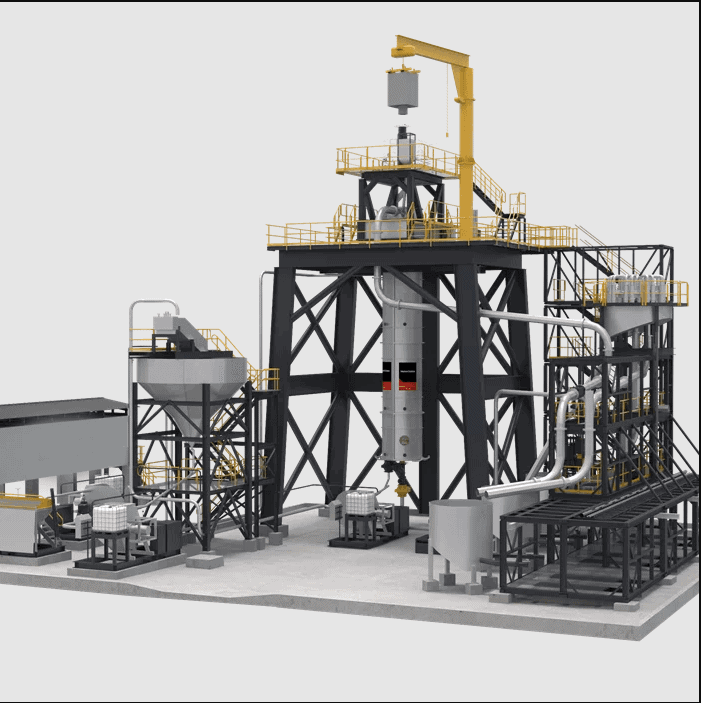
Figure 7- HIGmill Asia