


Copper Processing
Copper ores are generally classified into three main categories based on their degree of oxidation:
- Sulfide ores
- Oxide ores
- Mixed sulfide–oxide ores
The major copper-bearing minerals found in nature include:
- Sulfide Minerals: Chalcopyrite (CuFeS₂), Covellite (CuS), Chalcocite (Cu₂S), Bornite (Cu₅FeS₄), and Cubanite (CuFe₂S₃)
- Carbonate Minerals: Malachite (Cu₂CO₃(OH)₂) and Azurite (Cu₃(CO₃)₂(OH)₂)
- Oxide Minerals: Tenorite (CuO) and Cuprite (Cu₂O)
- Chloride Minerals: Atacamite (Cu₂Cl(OH)₃)
- Silicate Minerals: Chrysocolla ((Cu,Al)₂H₂Si₂O₅(OH)₄·nH₂O)
The copper extraction route depends primarily on the mineralogical composition and oxidation state of the ore deposit. Sulfide ores are generally processed through flotation followed by pyrometallurgical treatment, while oxide ores are commonly processed using hydrometallurgical methods. Overall, approximately 80% of mined copper production is derived from sulfide minerals and processed through pyrometallurgical routes.
Pyrometallurgical copper extraction typically involves crushing, grinding, classification, concentration through direct flotation, concentrate production, smelting, and thermal and electrolytic refining.
Hydrometallurgical copper extraction generally includes crushing, leaching, solvent extraction (SX), precipitation or solution treatment, and electrowinning (EW). Both processing routes can ultimately produce high-purity copper cathode.
In the copper processing industry, crushing and grinding technologies have evolved from conventional circuits comprising primary jaw crushing, secondary and tertiary cone crushing, and ball mill toward more advanced configurations. The first generation of large-scale circuits incorporated primary gyratory crushing followed by SAG mill and ball mill, while second-generation circuits Including initial gyratory crushing, SAG mill, cone crushing to remove particles with critical dimensions, and then ball mill. As a result, SABC (SAG Mill–Ball Mill–Crusher) circuits are now widely used in the design of large capacity copper concentration plants.
Over recent decades, the introduction of High-Pressure Grinding Rolls (HPGR) has generated significant interest as an alternative to conventional autogenous and semi-autogenous grinding circuits. HPGR applies high compressive forces to ore particles, generating microcracks and intergranular fractures that can enhance downstream grinding performance. Although HPGR circuits have been implemented at several large-scale mining operations worldwide, SABC remains one of the dominant crushing and grinding configurations in large capacity copper concentration plants.
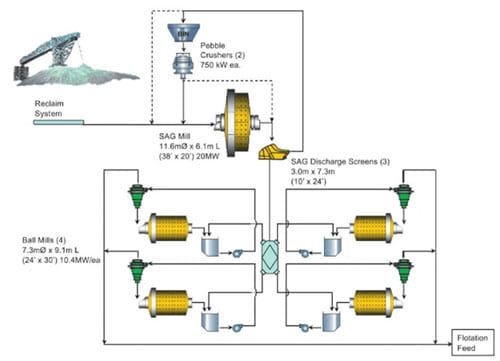
The product discharged from the grinding circuit consists of finely ground ore in the micron-size range, which is transported as pulp to the flotation unit. In order to produce a final copper concentrate with the required grade and maximum recovery, flotation circuits are typically configured as banks of flotation cells incorporating various combinations of rougher, cleaner, and scavenger stages. Different flotation cell designs, tank geometries, and aeration mechanisms may be selected depending on the ore characteristics and process requirements. Since many copper sulfide ores occur as complex polymetallic mineral assemblages, valuable elements such as gold, silver, and molybdenum may occur as associated or paragenetic minerals. These valuable elements may therefore be recovered either together with copper or through subsequent selective concentration and separation stages.
The final copper concentrate discharged from the flotation circuit is first thickened in concentrate thickeners to increase the solidity and is then transferred to the filtration section for further dewatering and separation of the liquid and solid phases. The filter cake is subsequently transferred to concentrate drying units to remove residual moisture before being fed to the smelting furnaces. The dried concentrate is fed to the smelting furnaces, where it is subjected to high-temperature treatment. The resulting molten product contains copper along with impurities such as sulfur, iron, gold, and other elements and typically contains approximately 45% copper. This intermediate product is known as copper matte.
The copper matte is transferred to converters, where air and oxygen are used to oxidize impurities, particularly iron and sulfur. The oxidized impurities are removed with the slag. The copper produced during converting is still impure and contains various metallic and non-metallic elements as well as entrained gases and porosity. This intermediate product is known as blister copper or crude copper.
Blister copper typically contains more than 99.3% copper. It is transferred by ladles to anode furnaces, where further refining is performed to remove residual impurities. Hydrocarbon fuel or reducing gases may be used during the final refining stage to control the oxygen content and improve copper quality. The refined molten copper, typically reaching approximately 99.7% copper, is then transferred to an anode casting wheel, where it is cast into large copper plates known as anodes for subsequent electrolytic refining.
The copper anodes are immersed together with starter sheets or cathode blanks in an electrolyte solution containing sulfuric acid and copper sulfate. When a controlled direct current is applied, copper dissolves from the anode as Cu²⁺ ions and is subsequently deposited onto the cathode surface as high-purity metallic copper. Most impurities either remain in the electrolyte or form anode slime that settles at the bottom of the electrolytic cells. The anode gradually dissolves during electrolysis while copper is deposited onto the cathode. The resulting cathodes constitute the final high-purity copper product, typically reaching approximately 99.99% Cu, depending on the refining process and operating conditions. These copper cathodes are then ready for use in downstream industrial applications and commercial markets.