Iron Ore Processing
Hematite
In addition to their significant difference in specific gravity compared with associated gangue minerals, hematite minerals exhibit relatively weak magnetic absorption and are classified as paramagnetic minerals. This property can be advantageous in facilitating their beneficiation. Various methods have been developed for the beneficiation of hematite ores, primarily aimed at achieving effective separation, producing a high-quality concentrate, and minimizing operating costs. Eventually, these processes are intended to produce an iron ore product suitable for downstream steelmaking processes, including pelletizing, blast furnace operations, and other ironmaking routes.
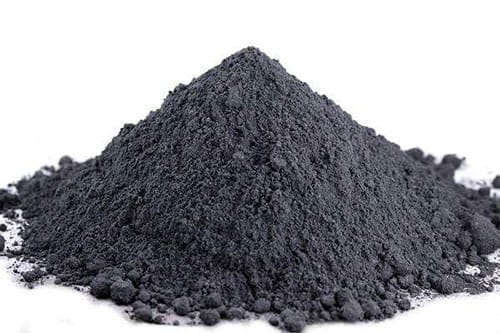
Iron Concentrate
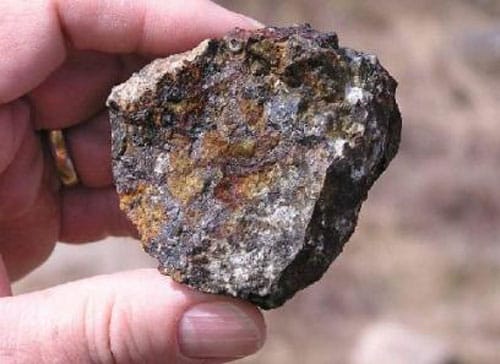
Hematite Ore
The principal beneficiation methods include:
- Magnetic Separation
- Gravity Separation
- Flotation
In general, the beneficiation method is selected to achieve an iron ore concentrate with the highest possible Fe grade and maximum recovery. The primary criteria for selecting and applying beneficiation methods to mineral ores include process simplicity, ease of operation, and operational reliability, while simultaneously meeting the specified quantitative and qualitative targets for the final concentrate.
The quality of an iron ore concentrate is generally evaluated from two main perspectives: Fe grade and the content of major undesirable elements remaining in the final product. These impurities typically include silica (SiO₂), phosphorus (P₂O₅), alumina (Al₂O₃), calcium oxide (CaO), magnesium oxide (MgO), sulfur (particularly in magnetite ores), and, in some cases, titanium dioxide (TiO₂). Therefore, finalizing the beneficiation flowsheet requires achieving both the required iron grade and impurity specifications.
Magnetic Separation
Magnetic separation can be applied to paramagnetic iron ores under high magnetic field intensity and high magnetic field gradient conditions. This approach can produce a concentrate with the required Fe grade and recovery. In most applications, magnetic separation is implemented through multi-stage circuits, typically incorporating rougher, cleaner, re-cleaner, and scavenger stages, depending on the ore characteristics and concentrate quality requirements.
Gravity Separation
Gravity separation including jigs, spirals, and heavy-media separators, can be used during the early stages of beneficiation in either single-stage or multi-stage configurations. These systems are capable of producing high-grade products that may, in some cases, be directly recovered as the final concentrate.
To maximize concentrate recovery, combined gravity and magnetic separation circuits may be employed. Additional beneficiation stages, such as magnetic separation as a scavenger stage or flotation as a cleaner stage, can also be applied to improve recovery or enhance the quality of the final concentrate.
Certain gravity separation technologies are particularly suitable as secondary beneficiation stages, especially in circuits incorporating magnetic separation. Many of these technologies fall into the categories of hydraulic classifiers and centrifugal concentrators. By providing enhanced separation efficiency, these systems can effectively separate concentrate particles from associated gangue minerals.
Flotation
Flotation is frequently used as a final cleaning and upgrading stage in integrated circuits combined with magnetic and/or gravity separation processes. The primary objectives of flotation are to increase the Fe grade of the final concentrate and reduce undesirable impurities, particularly silica, phosphorus, alumina, calcium, and magnesium.
In general, phosphorus removal from iron concentrates can be achieved relatively effectively. However, the major challenge is the removal of silica and aluminosilicate gangue minerals from produced concentrates. When silica is primarily associated with quartz minerals, reverse flotation can effectively remove silica from the concentrate with relatively high efficiency. However, when silica originates from iron-bearing silicate or aluminosilicate minerals, their effective flotation and removal can be considerably more challenging. Consequently, flotation performance in reducing silica content may be limited. Recent developments by chemical reagent providers include the application of blended collectors, consisting of combinations of different collector types, as well as collectors with modified molecular structures, to improve the selective removal of these impurities.
In cases where the iron ore exhibits very low magnetic absorption and the silica impurities are primarily associated with quartz, multi-stage flotation may be technically feasible for producing the final concentrate without requiring additional beneficiation stages prior to flotation. This approach has been applied in certain iron ore operations in Brazil and China.
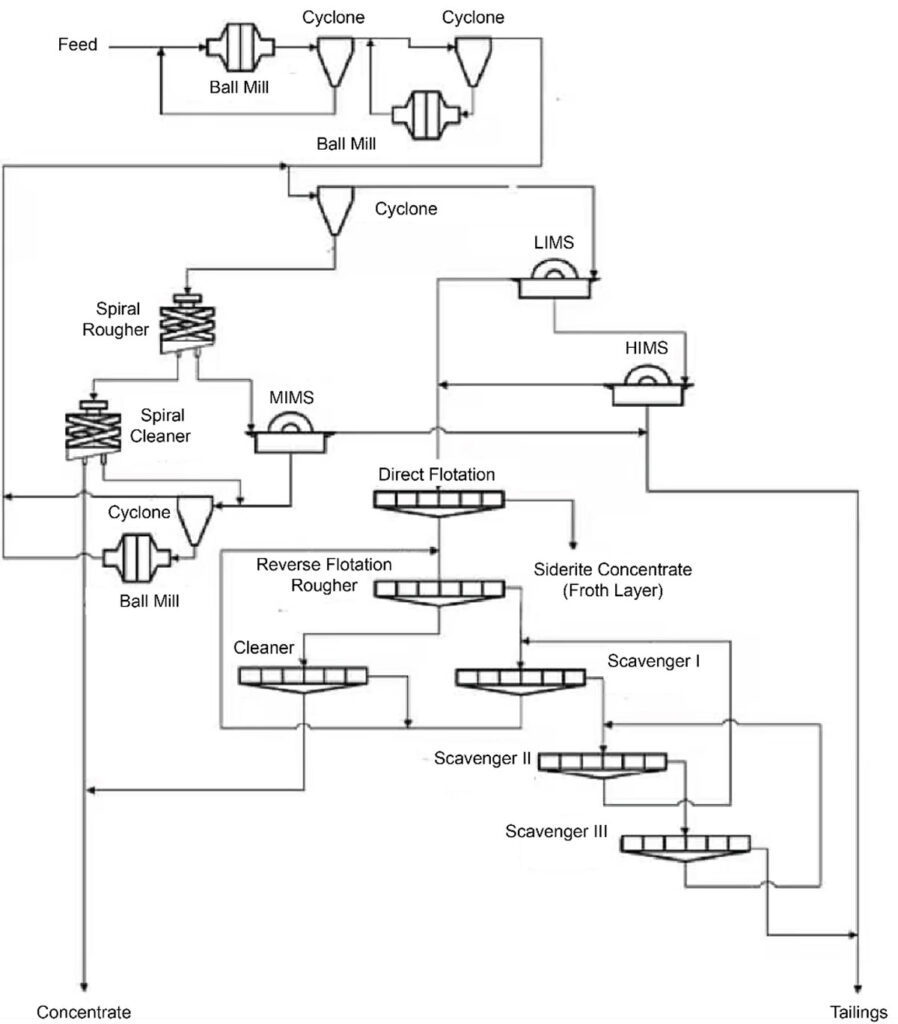
Overall, evaluation of different process circuit configurations indicates that, for the beneficiation of paramagnetic iron ores and effective separation of iron-bearing minerals from associated gangue, the following integrated circuits can provide suitable alternatives for technical evaluation and optimum flowsheet selection:
- Multi-stage magnetic separation (Rougher–Cleaner and Scavenger) followed by flotation as a final cleaning stage (Final Cleaner)
- Multi-stage magnetic separation (Rougher–Cleaner and Scavenger) followed by gravity separation using hydraulic classifiers and centrifugal concentrators as the final cleaning stage (Final Cleaner)
- Multi-stage gravity separation (Rougher–Cleaner) followed by magnetic separation (Scavenger–Cleaner Scavenger)
- Multi-stage gravity separation (Rougher–Cleaner and Scavenger) followed by flotation as a final cleaning stage (Final Cleaner)
- Multi-stage gravity separation (Rougher–Cleaner) followed by magnetic separation (Scavenger–Cleaner Scavenger) and subsequent flotation as a final cleaning stage (Final Cleaner)
- Multi-stage flotation (Rougher–Cleaner and Scavenger)
The figure below presents an example of an integrated process flowsheet for an iron ore concentrate production plant.